Big backup or budget backup: Anker C1000 Gen 2 vs EcoFlow River 2
If you’re choosing between these two portable power stations, you’re really choosing between two very different classes of kit. The Anker SOLIX C1000 Gen 2 is a high-capacity, high-output unit aimed at home backup, longer outages, and power-hungry appliances, while the EcoFlow River 2 is a compact entry-level option for phones, laptops, lights, and light camping use. For UK buyers, the right pick depends on whether you want genuine outage resilience or simply a cheap, portable battery with fast charging. Here’s the definitive head-to-head.
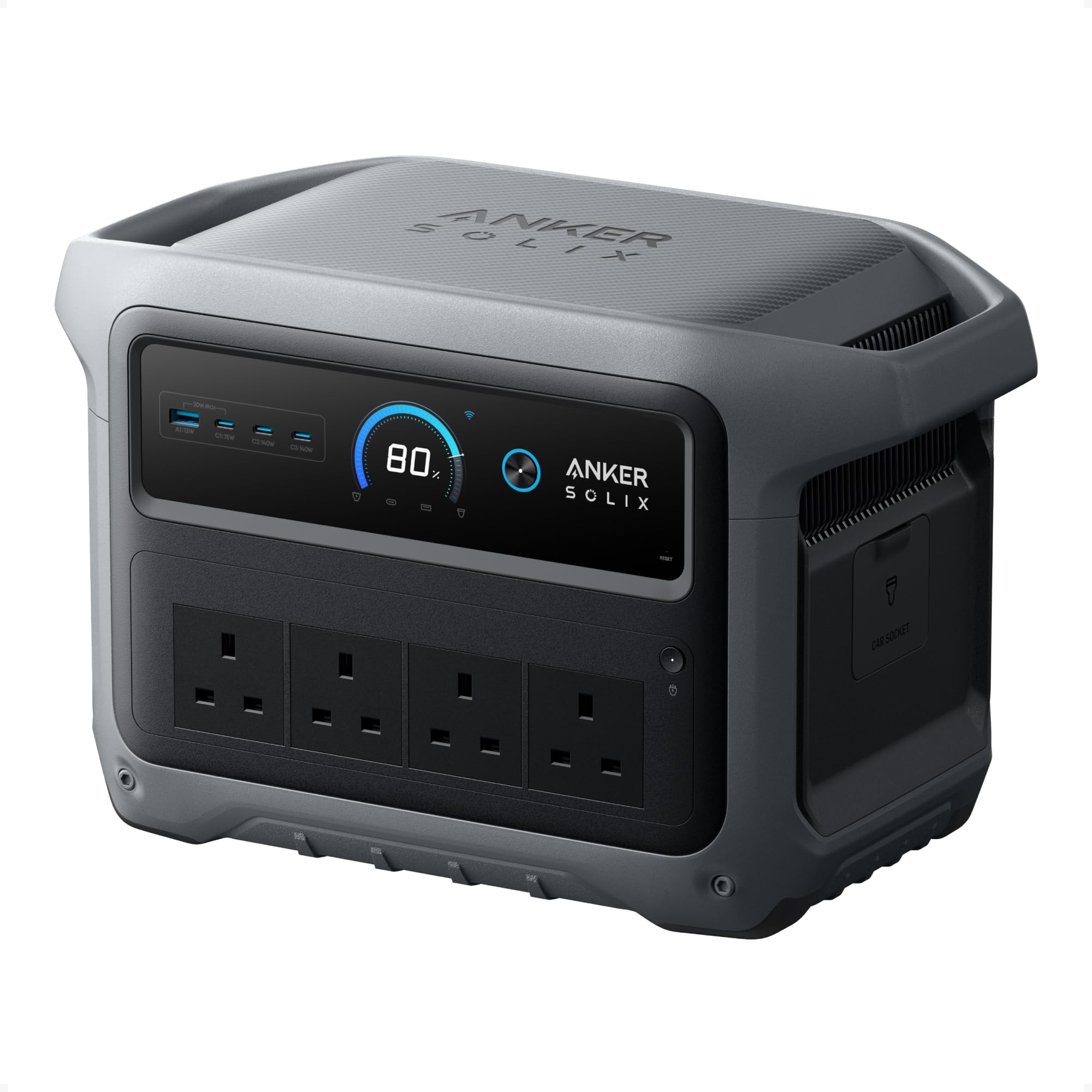
Anker SOLIX C1000 Gen 2 Portable Power Station, 2,000W (Peak 3,000W) Solar Generator, Full Charge in 49 Min, 1,024Wh LiFePO4 Battery for Home Backup, Power Outages, and Camping

ECOFLOW Portable Power Station RIVER 2, 256Wh LiFeP04 Battery/ 1 Hour Fast Charging, Up To 600W Output, Solar Generator (Panel Not Inc.) for Outdoor Camping/RVs
Our Recommendation
The Anker SOLIX C1000 Gen 2 is the better buy because it offers far more usable power: 1,024Wh versus 256Wh and 2,000W output versus 600W. That makes it suitable for real backup use, not just device charging. Its 49-minute full charge and LiFePO4 battery chemistry also make it a stronger long-term investment. The EcoFlow River 2 is cheaper, but it is a much smaller-class product.
Detailed Comparison
Display
Neither product is sold as a display-first device, so this category is less about screen quality and more about usability. The Anker SOLIX C1000 Gen 2 typically makes more sense for real-world monitoring because a larger, higher-end power station usually provides clearer status readouts for input, output, battery percentage, and estimated runtime. EcoFlow’s River 2 is simpler and more basic, which is fine for casual use but less reassuring when you’re trying to manage a blackout or run multiple devices. Winner: Anker, because better monitoring matters more when backup power is mission-critical.
Performance
This is the biggest gap. The Anker delivers 2,000W continuous output with 3,000W peak, which puts it in a completely different league from the River 2’s up to 600W output. That means the Anker can handle kettles only in some cases depending on surge, microwaves, power tools, and more demanding household loads, while the EcoFlow is mainly for low-draw electronics, routers, fans, laptops, and small appliances. Battery capacity is also vastly different: 1,024Wh for the Anker versus 256Wh for the EcoFlow. In practical terms, the Anker gives roughly four times the energy storage and far more usable headroom. Winner: Anker, by a wide margin.
Build quality and design
Both brands have strong reputations, and both use LiFePO4 chemistry, which is the right choice for longevity and safety compared with older NMC-based designs. The Anker’s larger capacity and higher output mean it will naturally be bulkier and heavier, but that’s the trade-off for serious capability. The EcoFlow River 2 is easier to carry, easier to stash in a flat or car boot, and better suited to occasional use where portability matters more than raw power. If you want a grab-and-go unit, EcoFlow has the simpler physical package; if you want a robust home-backup appliance, Anker’s design is more appropriate. Winner: tie, because each is well designed for its intended job.
Battery life
On paper, the Anker is the clear winner again. A 1,024Wh LiFePO4 battery gives far more runtime and is better suited to keeping essential devices running through a prolonged outage. The River 2’s 256Wh battery is enough for short-term use, but it will drain quickly once you start charging multiple devices or powering anything beyond a laptop and a few accessories. LiFePO4 is a plus for both, with long cycle life and better thermal stability than NMC, but capacity still dominates here. Winner: Anker.
Price and value for money
This is where EcoFlow has a real advantage. At £219, the River 2 is £380 cheaper than the Anker, and for basic portable power that is a very attractive price. If your needs are limited to camping, charging devices, and occasional small loads, the EcoFlow is much easier to justify. But value is not just about the sticker price; it’s about what you get per pound. The Anker’s extra £380 buys you four times the battery capacity and more than triple the output headroom, which is excellent value if you actually need that level of performance. For light-duty users, EcoFlow wins on affordability. For serious backup users, Anker wins on value. Overall winner: EcoFlow for budget buyers, Anker for capability-per-pound.
Game library/features
For portable power stations, the real equivalent of a “game library” is feature set: charging speed, output versatility, app monitoring, and backup usefulness. The Anker’s headline 49-minute full charge is a major advantage, especially if you want to recharge quickly between outages or on a campsite hookup. Its 2,000W output also broadens the range of appliances it can support. The EcoFlow River 2 also offers fast charging, around 1 hour, which is excellent for its class, but its feature set is constrained by the much lower output ceiling and smaller battery. Winner: Anker, because the combination of rapid charging and high output is more useful overall.
Overall user experience
The EcoFlow River 2 is the easier recommendation if you want a simple, affordable battery for occasional portable use. It is light, cheap, and fast to recharge, so it suits renters, flat-dwellers, and campers who mainly need to keep phones, tablets, lights, and a laptop going. The Anker SOLIX C1000 Gen 2 is the better product if you want real resilience: it can cover more devices, last much longer, and cope with far more demanding loads. In UK terms, the Anker is the one you buy if you want a credible backup for power cuts or a more serious off-grid setup without needing an electrician. The EcoFlow is the one you buy if you want the lowest-cost entry into portable power and can live with the limited capacity. Overall summary: the Anker is the superior power station, but the EcoFlow is the better budget buy.
Final verdict
If you need one definitive answer, buy the Anker SOLIX C1000 Gen 2. It is dramatically more capable, with 2,000W output, 1,024Wh capacity, and LiFePO4 durability that makes it suitable for genuine home backup as well as camping. The EcoFlow River 2 is good value, but it belongs in the lightweight, low-demand category and will feel underpowered much sooner. Choose the EcoFlow only if your budget is tight and your loads are modest; otherwise, the Anker is the smarter long-term purchase.
Buy the Anker SOLIX C1000 if...
Buy Product A if you want a serious backup battery for power cuts, longer camping trips, or running higher-draw appliances like a microwave, kettle, or power tools within its limits. It is also the better choice if you want one unit that can cover both home backup and portable use without constantly worrying about capacity. In short: buy A if you want capability first and price second.
Buy the ECOFLOW Portable Power if...
Buy Product B if your main use is charging phones, laptops, cameras, lights, or a small fan, and you want the lowest upfront cost. It is also a smart pick if you need something lighter and easier to carry for occasional camping or day trips. Buy B if you know you do not need serious appliance support and just want a compact, fast-charging battery.
Curated by The Solar Plug on All The Top Picks
As an Amazon Associate we earn from qualifying purchases.